Everyone is buying AI right now. Almost nobody is becoming an AI-native company.
Those are two very different things, and the gap between them is where most of the money is quietly disappearing. A company buys seats for a chatbot, runs a prompting workshop, ships a pilot that never touches a real workflow, and six months later it runs exactly the way it did before. The tools are impressive. The company is unchanged.
I want to make a claim that sounds backwards, and then show you why it is the most practical thing I know about this whole subject.
The first thing you build in an AI-native company is not AI. It is memory.
Most “AI transformation” is theater
Let me say the quiet part out loud, because I have watched a lot of people get sold the theater version.
The theater looks like this: an inspiration keynote, a tour of the newest models, a slide about the future, maybe a single automation that demos beautifully and breaks the moment it meets a real edge case. It is advice from people who have read about AI but have never had to make payroll, never run a support queue at 2am, never had a key person quit and take half the company’s knowledge with them.
The real work looks different, and it is less glamorous. You map how the work actually happens, not the org chart, the real flow of decisions and handoffs and busywork. You sort what stays human, judgment, relationships, taste, from what AI should carry, coordination, reporting, routine execution, the endless re-explaining. And then you prove it with numbers before anything gets handed over.
I did not arrive at this from a whiteboard. I arrived at it by doing it to my own companies first, and getting it wrong enough times to see what the missing piece was.
Why the tools keep failing you
Here is the thing nobody selling you a demo wants to dwell on: every AI tool today has amnesia.
You open a fresh chat and it knows nothing about your business. You explain your situation, your customers, your history, your constraints. It gives you a decent answer. Tomorrow you open it again and you start from zero. Switch to a different tool and you re-explain everything a third time. The intelligence is real, but it is floating in a vacuum, disconnected from everything that makes your company yours.
A company is not smart because it has smart tools. A company is smart because it remembers. It remembers why you fired that customer, what you promised that supplier, which pricing experiment failed and why, what the person who left in March actually knew. Strip the memory out and the smartest tools in the world give you generic answers to a business they have never met.
So the foundational building block is the layer that fixes the amnesia. One shared, permanent memory that every tool, and every person, draws from. We call ours the Context Engine, and it is the thing I would install before I touched a single fancy automation.
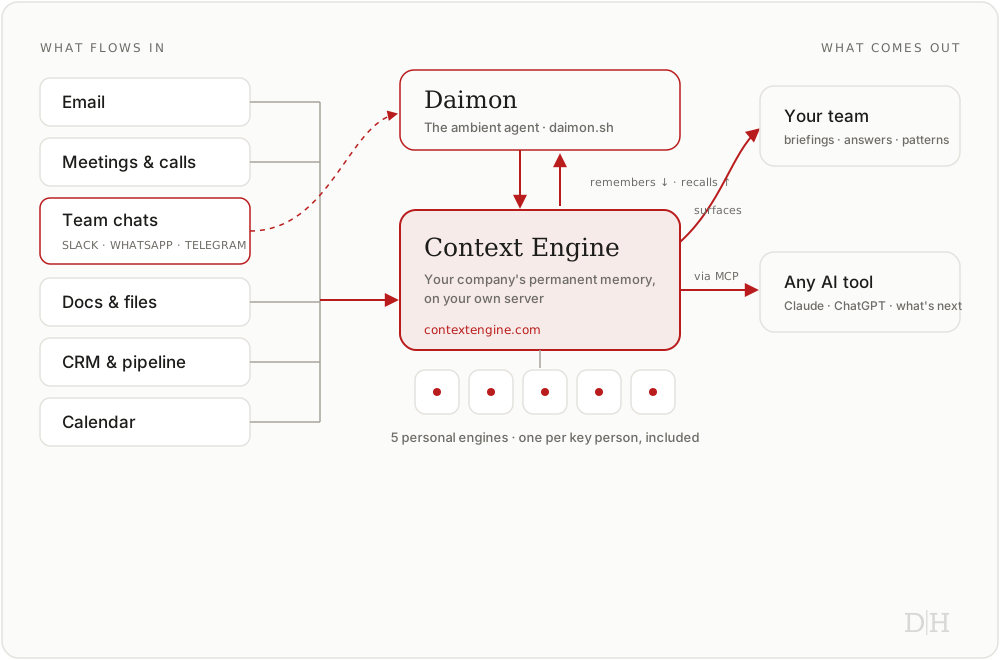
Everything your company knows flows into one memory. Daimon sits in the chats your team already uses, on Slack, WhatsApp, or Telegram, and keeps that memory alive. Then any tool, or any person, can draw on it.
The proof came from my own portfolio
I run a portfolio of real companies, and I mean real in the boring, operational sense. Customer support and CX. Recruiting and people work. Marketing. SaaS. Customer reactivation. Queues, hiring funnels, churn, SLAs, pipelines. Not slideware.
We rebuilt each one around AI ourselves, and each one taught us something specific about where AI genuinely absorbs load and where it quietly makes things worse:
- LTVplus (customer support, scaled past hundreds of agents) taught us where AI absorbs support load without wrecking the customer relationship, and where a human still has to step in.
- LoveNotFear (recruiting and people work) taught us what actually changes for people when AI enters the org, in hiring, onboarding, and retention.
- Shortlist (marketing) taught us where AI multiplies real output and where it just produces slop that someone else has to clean up.
- upcoach (SaaS and coaching) taught us product, activation, and retention from the inside of a software company.
- WinbackEngine (customer reactivation) was built AI-first from day one, so it taught us the retention economics of doing this from scratch.
The pattern across all of them was the same. The automations that stuck were the ones sitting on top of a shared memory. The ones that failed were the clever point solutions that started from zero every time. That is not a coincidence. That is the whole lesson.
We got so excited by the results that we turned the playbook into a company. But the sequence never changed: memory first, then everything else.
The layer almost everyone skips
This is not a framework I invented. The clearest map of how a company built around AI actually operates comes from ExO 3.0, The Organizational Singularity, by Salim Ismail and colleagues, the follow-up to the original Exponential Organizations. The idea is that an AI-native organization runs as a continuous loop, at machine speed: it senses what is happening, interprets it against everything the company knows, decides, acts, and learns from the outcome. A purpose sets the goals and the hard constraints up top, and governance wraps the whole thing so a human stays in control and nothing runs off the rails.
Plenty of people have read the book. The difference is that we actually build the loop, layer by layer, inside real companies. That is what the whole engagement is: installing this stack where a pile of disconnected tools used to be.
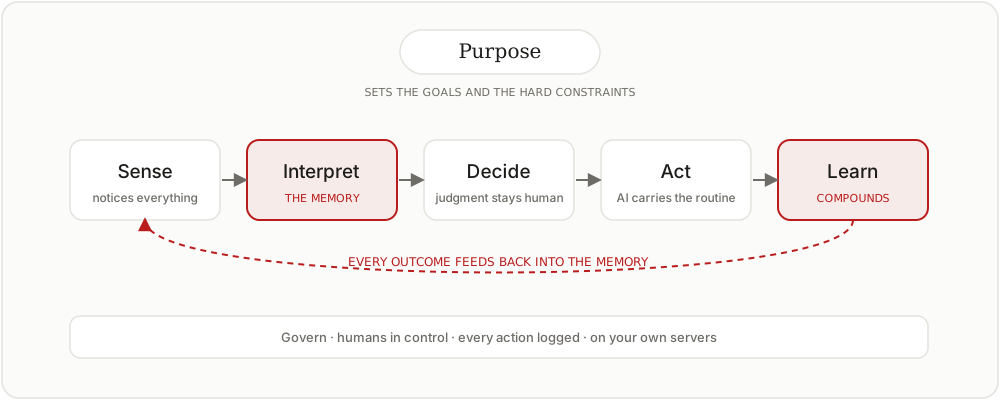
The two highlighted layers, Interpret and Learn, are the ones almost nobody builds. They make no demo, so they get skipped. They are also the only reason the system gets smarter every month.
Most companies buy a chatbot, which is a sliver of the “act” layer, and stop. They never build the two layers that actually compound.
The first is interpret. This is the memory: signals become understanding because history gets retrieved and context gets attached. This is the Context Engine, and it is the layer almost every company is missing.
The second is learn. Every outcome feeds back into the memory, so the system in month six is measurably smarter than in month one. Nobody builds this either, because it is invisible in a demo. It only shows up over time.
That is the contrarian core of it. The parts of AI that make the best demos, the flashy generation, the clever one-off automation, are the parts that matter least to whether your company is genuinely transformed. The parts that make no demo at all, memory and learning, are the parts that decide everything. Setup porn photographs well. Compounding does not.
What memory actually buys you
When the foundation is a shared memory instead of a pile of disconnected tools, the wins stop being abstract:
- You stop losing tribal knowledge. When someone leaves, what they knew and decided stays in the company’s memory, searchable and usable.
- New hires are useful in days, not months. They start with the full history of the company instead of six months of asking around.
- Coordination cost collapses. Status meetings, reporting, chasing updates, AI carries it, and department cost as a share of revenue goes down as you grow instead of up.
- Every tool knows your business. No more generic answers, and no re-explaining yourself when you switch tools.
- It compounds. Every call, decision, and document makes the system smarter. Month twelve beats month one by a wide margin.
None of that comes from a better model. All of it comes from the memory underneath.
Own the asset
One more contrarian point, because it matters more than people realize when they are shopping for AI.
Your company’s memory is the most valuable, most private asset you will build in this whole process. It should not become someone else’s asset, train someone else’s model, or lock you into a vendor forever. Ours runs on servers you own, with your data under your control, GDPR compliant by design. When the work is done, the software and the license are yours. Success, for me, is a client needing us less every month, not a dependency that renews forever.
That is the opposite of how most of this gets sold. It is also the only version I would be willing to install in my own companies, which is the only test I actually trust.
Where to start
If you are staring at the AI hype and wondering where to begin, here is the honest answer, stripped of theater.
Do not start with the model. Do not start with the flashiest automation you can demo on Friday. Start by giving your company one shared, permanent memory. Get the interpret and learn layers in place. Then let the “act” layer sit on top of a foundation that actually remembers your business. Everything else you build after that gets better, because it is finally standing on something.
Ask the question about your own company: if you built it from scratch today, with AI, what would it look like? Then go build the memory first. The rest follows.
Much love.